
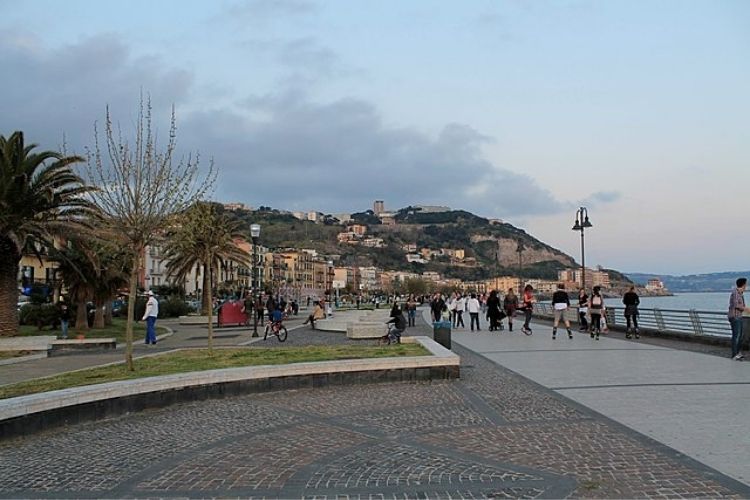
Pozzuoli is a city in the Metropolitan City of Naples. It is located in the Campania region of southern Italy. The city is famous for its dramatic volcanic activity, striking Roman ruins, and its historical role as the primary commercial port of ancient Rome– where the Apostle Paul once landed. There is even a sign in the harbor marking the spot where he disembarked,
The city’s attractions include the Flavian Amphitheatre, Italy’s third-largest Roman arena which hosted massive gladiator spectacles under the Roman emperors. The Macellum of Pozzuoli, also known as the Temple of Serapis, which was a marketplace, and is considered the city’s symbol.
Pozzuoli was founded in 531 BC as the Greek colony of Dicaearchia by refugees fleeing from a tyrant on the Greek island of Samos. Following the Romanization of Campania, in 194 BC, Rome established a colony at Puteoli, as it was then known. The region was important for its pozzolanic ash, a volcanic sand that was essential for producing the ultra-durable Roman concrete.
In Roman times
The pretty seaside city of Pozzuoli has many interesting sites, especially Roman artifacts. It was an important harbor that imported grain and other goods from around the world. The city exported goods such as blown glass, mosaics, wrought iron, and marble. The nearby port of Misenum also housed the largest naval fleet in the ancient world.


What I find most interesting about Pozzuoli is that the Apostle Paul stayed there on his way to be imprisoned in Rome. After spending seven days there, he and his companions traveled north to Rome along the Appian Way to Rome, a journey of 170 miles or 274 km. I find it so fascinating to be able to trace the footsteps of important historical figures on our travels!


Campi Flegrei Volcano
The Campi Flegrei, also known as the Phlegraean Fields, a massive volcanic caldera located beneath a portion of the city of Naples where 500,000 people reside. It is considered a super volcano. The city of Pozzuoli sits in the middle of the caldera.
A caldera is a giant bowl-shaped depression formed when a volcano erupts violently expelling large amounts of ash and lava very quickly. The deep underground chamber loses its support, causing the top and sides of the volcano to cave in and collapse. This creates volcanic vents that are much wider than normal ones, often spanning miles.
Calderas are usually considered dormant (or active but sleeping) because massive supervolcanoes and collapse systems require immense amounts of time to recharge their magma chambers. However, “dormant” does not mean dead. Many calderas, including Campi Flegrei, exhibit ongoing hydrothermal activity or seismic unrest.
Scientists warn that although Campi Flegrei has long been quiet, it may be waking up and approaching a “critical state.” Volcanic activity peaked in 1983, destroying 8,000 buildings and raising the seafloor by nearly two meters, making the bay too shallow for large ships.
Fortunately, scientists can monitor volcanic activity fairly accurately. So don’t let the Campi Flegrei hinder you from visiting this interesting area of Italy. It’s worth a visit!
Photo credits: Panorama of pozzuoli by Patrick Nouhailer | Panorama of pozzuoli port by Roberto De Martino; Pozzuoli amphitheater by Miguel Hermoso Cuesta | Others are mine or used according to Canva’s content license agreement..


Leave a Reply